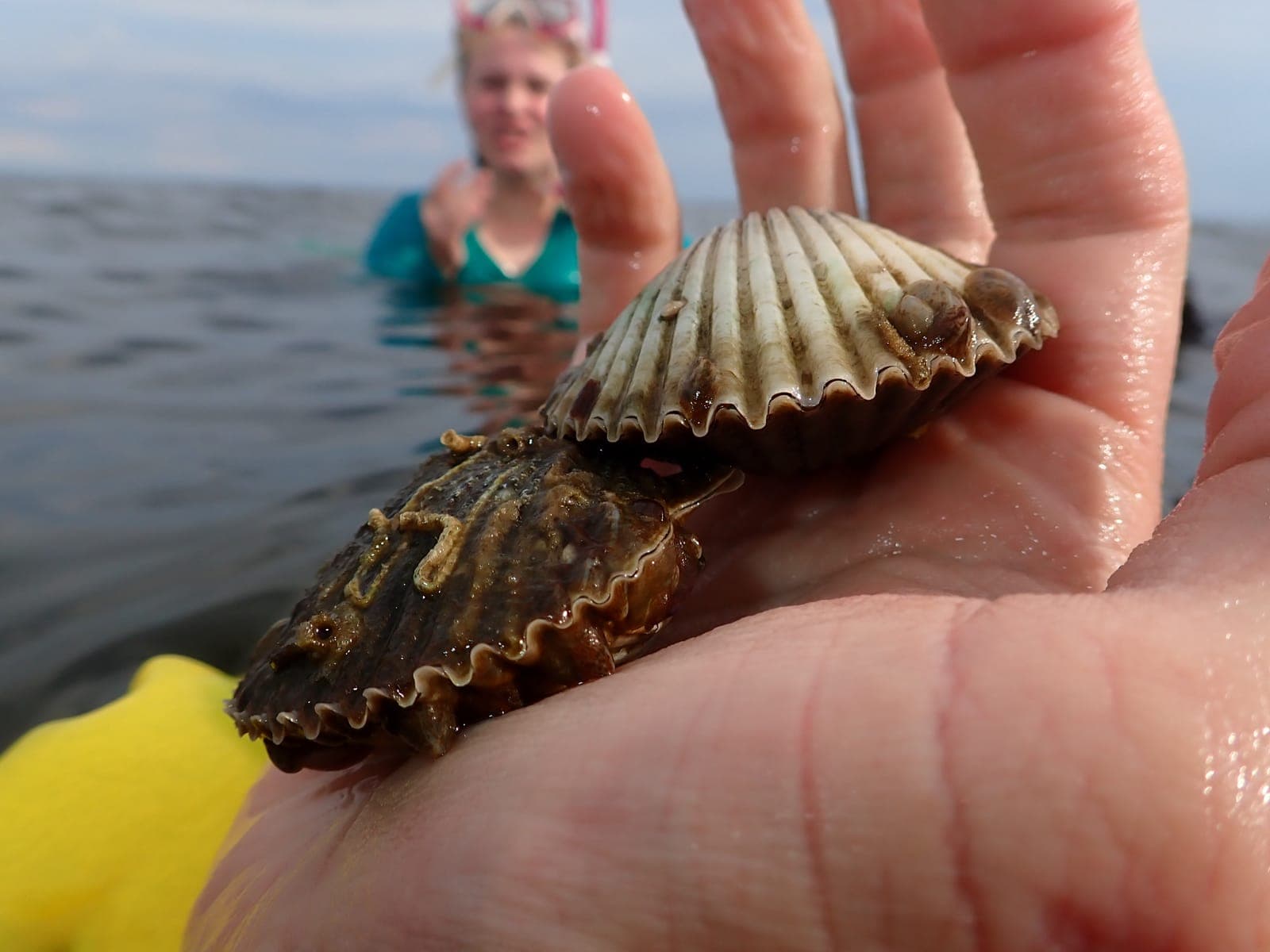
Short answer: Look for seagrass in clear, salty water about 4 to 8 feet deep, inside an open zone during its season. Go on a calm, sunny day, check the tide first, swim slowly, and look for fan-shaped shells with a row of small blue eyes.
Habitat
Bay scallops live on seagrass beds in shallow, nearshore water.
Young scallops attach to grass blades with thin threads, then drop to the bottom as they grow. That's why you find adults sitting in and around the grass, not on bare sand far from it. No grass, no scallops.
Florida's three main scalloping grounds are St. Joseph Bay, the Dixie-Taylor area, and Citrus County.
Depth
Most scalloping happens in 4 to 8 feet of water, and some beds run as deep as 10 feet.
That depth is easy to snorkel. You can float on the surface, see the bottom, and dive down for each one. Shallower water near shore can hold a few scallops, but wading and dip-netting from a skiff aren't very productive compared with snorkeling from an anchored boat.
Water Clarity
If you can't see the bottom, you won't see scallops. Move until you can.
- Clear water and shallow depth are what make an area good for scalloping.
- Sun high overhead makes shells easier to spot. Clouds and wind-chop make it harder.
- If one spot is murky, try a little farther out or along a different stretch of grass.
Tide
Check the tide before you leave the ramp.
- Depth, clarity and current can all change quickly as the tide moves.
- A falling tide can strand a boat on a shallow grass flat.
- Start each swim heading into the current so the return trip is easier.
Weather, Rain & Runoff
Scallops do better in salty water, so areas near river mouths can be thin, especially after heavy rain.
- In Hernando County, water near Bayport and Hernando Beach is less salty because of the Weeki Wachee and Chassahowitzka rivers, and most scallops are 4 to 5 miles out.
- Big rains also cloud the water.
- Summer afternoon storms are common. Get out early and leave early.
- Red tide and other harmful algae can close a zone mid-season. FWC closed Pasco on August 6, 2026 after detecting toxin-producing algae.
What You're Looking For
A ridged, fan-shaped shell, usually under 3 inches, lying on the bottom in or near the grass.
- The eyes. A row of tiny bright blue eyes lines the edge of the shell. Once you spot them, you'll see scallops everywhere.
- The edges. Scallops often sit where sand patches meet the grass.
- Movement. A scallop can swim by clapping its shell. It won't go far. Watch where it lands.
Reading the Grass
- Swim slowly. Fast swimmers pass over half the scallops.
- Part the grass gently with your hand where it's thick. Some scallops sit down between the blades.
- When you find one, slow down. Look around before you move on.
- If you find nothing in 10 or 15 minutes, get back in the boat and try another spot. Some beds are thin in a given year.
- Watch other boats, but give their flags room. Boats must stay 300 feet from a flag in open water or slow to idle speed.
It's good practice to release scallops under about 2 inches. They have little meat and a better chance to spawn in the fall.
Protect the Grass
The grass is the habitat. Damage it and you damage next year's scallops.
- Stay in marked channels. Charts show seagrass in light green or labeled "grs".
- Trim up and idle across shallow flats, or get out and walk the boat to deeper water.
- If you run aground, push off. Don't power off.
- Anchor in sand when you can.
Safety on the Flat
- Fly the divers-down flag while anyone is in the water. Take it down when everyone is aboard.
- Stay within 300 feet of the flag in open water, 100 feet in rivers, inlets and channels.
- Keep someone on the boat as a lookout when you can.
- Watch for other boats. They may not see you.
- Head in at the first sign of lightning. Florida has the highest density of lightning strikes in the U.S.