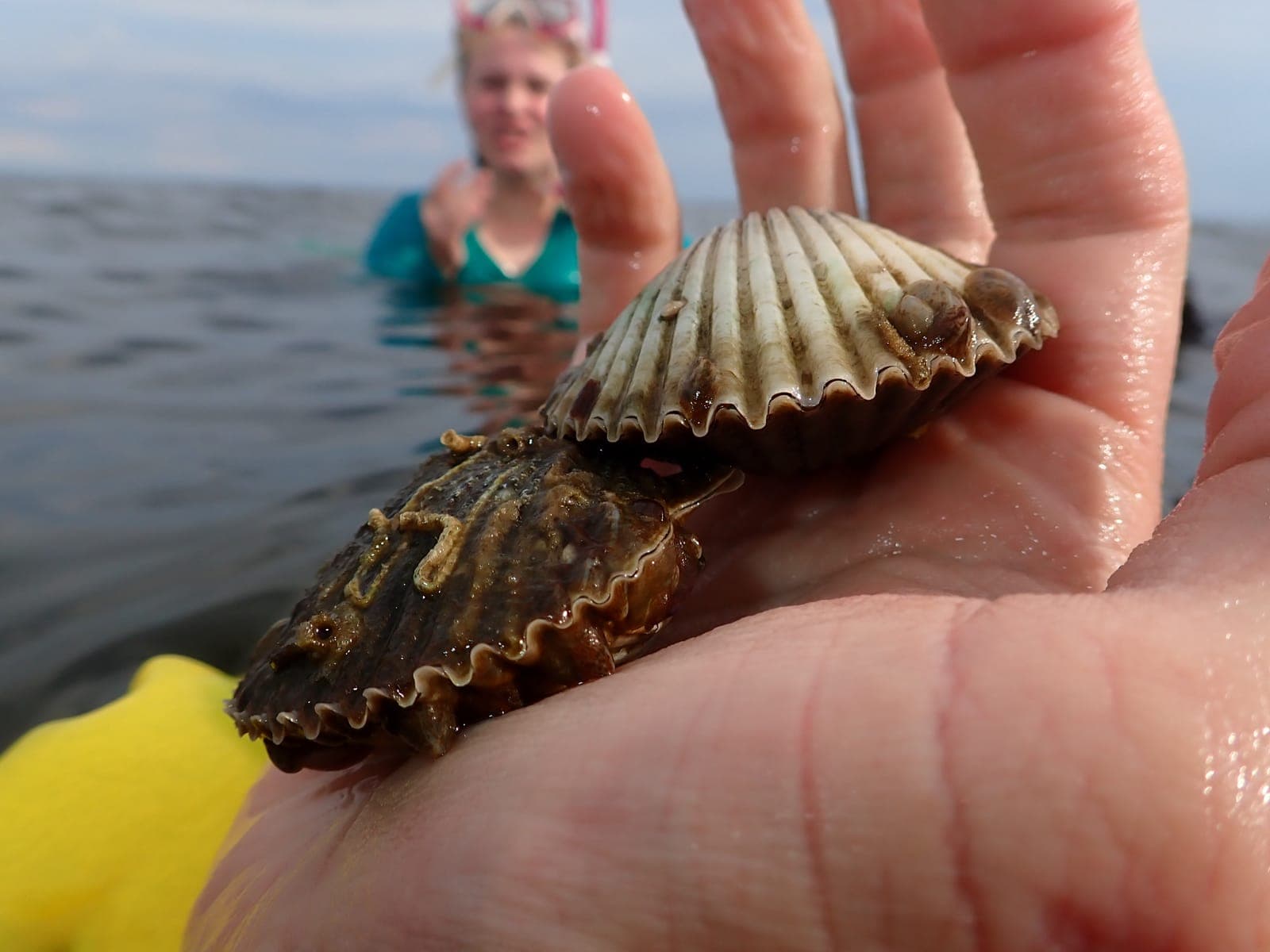
Bay scalloping on Florida's Gulf of America coast means snorkeling over shallow seagrass and picking scallops off the bottom by hand. You don't need dive training or special skills. You need an open zone, a boat (or a charter), a mask and snorkel, a mesh bag, a dive flag, and a cooler of ice.
Step 1: Pick an Open Zone & a Town
Only the Gulf coast from the Mexico Beach Canal in Bay County to the Anclote Key Lighthouse in northern Pinellas County is open, and it's split into five zones with different dates.
| Zone | Standard Season | Main Towns |
|---|---|---|
| Fenholloway through Suwannee River | June 15 to Labor Day | Keaton Beach, Steinhatchee, Horseshoe Beach |
| Franklin through northwestern Taylor | July 1 to September 24 | Carrabelle, Lanark, St. Marks |
| Levy, Citrus & Hernando | July 1 to September 24 | Cedar Key, Crystal River, Homosassa, Hernando Beach |
| Pasco | July 10 to August 18 | Hudson, Port Richey, New Port Richey |
| Gulf County (St. Joseph Bay) | August 16 to September 24 | Port St. Joe, Cape San Blas |
Those are the standard dates. FWC can close a zone early, and in 2026 it did: Pasco closed August 6 for toxic algae, and Gulf County never opened because scallop numbers were very low. Check the zone's status the week you go, and again the morning you launch.
How to choose:
- Go where the season is open on your dates. Late June means Fenholloway-Suwannee. Mid-August to late September leaves the July 1 zones, plus Gulf County if it opens.
- Pick a town with ramps and cleaners. Steinhatchee, Crystal River and Homosassa are busy scallop towns with marinas, rentals and charters.
- Expect crowds on opening weekend and holidays. Ramps fill early.
The three main scalloping grounds are St. Joseph Bay, the Dixie-Taylor area and Citrus County. Populations swing on roughly 5 to 7 year cycles, and FWC stopped publishing pre-season counts in 2019, so no one can promise a good year in advance.
Step 2: Charter or Do It Yourself
A charter is the easiest first trip. DIY makes sense if you already run a boat in shallow water.
A charter handles the boat, the spot, the flag and the safety gear. You don't need a fishing license on a boat that holds a valid charter license. Ask before you book: is cleaning included, is snorkel gear provided, and how many people share the boat? The 10 gallon vessel limit applies to charters too, so six people on one boat share the same 10 gallons.
DIY means renting or bringing a boat. Things to know:
- License: everyone 16 and older who isn't exempt needs a Florida saltwater fishing license.
- Boater education: if you were born on or after January 1, 1988, you need a boating safety education ID card to run a boat of 10 horsepower or more.
- The water is shallow. Runs to the grass can cross flats only a few feet deep, and an outgoing tide can strand a boat on the grass.
- Kayaks: in Hernando County, paddling out to the scallop grounds isn't a good idea. It's a long way out, and summer storms are common.
Step 3: Pack the Night Before
Pack a mask, snorkel, fins, a mesh bag, a divers-down flag, a cooler full of ice, and a life jacket for every person. The full list is on our what to bring page.
The flag must be at least 20 by 24 inches when flown from the boat. Kids under 6 must wear a life jacket on boats under 26 feet while underway.
Step 4: Get There Early
- Launch early. Afternoon thunderstorms are common in summer, so run to your farthest spot first and work back toward the ramp.
- Tell someone on land where you're going and when you'll be back.
- Check the tide before you leave. Depth, clarity and current change fast as it moves.
- Stay in marked channels and idle through shallow grass. Damaging seagrass is illegal in some state waters.
Step 5: Find a Grass Flat
Look for clear water about 4 to 8 feet deep over seagrass, and sometimes as deep as 10 feet.
- Look for a cluster of anchored boats with dive flags. Then give them room: boats must stay 300 feet from a flag in open water, or slow to idle speed.
- Clear water matters more than anything. If you can't see the bottom from the surface, move.
- Scallops do better in saltier water. Areas near river mouths can be thin after heavy rain.
- In Hernando County, most scallops are 4 to 5 miles offshore.
Anchor in sand if you can find it, not in the middle of the grass. More on this in how to find scallops.
Step 6: Flag Up, Then Get In
- Raise the divers-down flag at the boat's highest point.
- Put a lookout on the boat if someone can stay aboard.
- Swim into the current first. The trip back is easier.
- Stay within 300 feet of the flag in open water, 100 feet in rivers, inlets and channels.
Step 7: Spot & Grab
Float face down, look for a fan-shaped shell sitting on or between the grass blades, and grab it. Bay scallops have a row of tiny blue eyes along the shell edge. Once you see one, the next ones get easier.
- They often sit at the edge where sand meets grass.
- They can swim by clapping their shells, but not far. Follow it and grab it when it lands.
- Put them in a mesh bag, not your swimsuit. They can pinch.
- Small ones have little meat. It's good practice to release anything under about 2 inches.
Only hands or a dip net are allowed.
Step 8: Keep Them Cold
Get scallops onto ice in a cooler, or hang them in a mesh bag in the water, not in a bucket on a hot deck.
- Put a wet towel over the ice so meltwater doesn't run into the shells.
- Drain the meltwater during the day.
- If you use a hanging bag, pull it before you pull anchor and move the scallops to ice.
Step 9: Watch the Limit
Each person can keep 2 gallons of whole scallops in the shell, and the boat can hold 10 gallons total. In the Fenholloway-Suwannee Zone from June 15 to 30, it's 1 gallon per person and 5 per boat.
A 5 gallon bucket with marks at 1 and 2 gallons makes counting easy. A pint of meat, the one-person daily limit, is about four servings. Keep only what you'll eat.
Step 10: Head In
- Take the flag down before you move the boat. Flying it while underway is a violation.
- If your route crosses closed waters, go straight to where your boat is normally docked or stored. Don't stop.
- If you plan to shuck on the water, move away from people still scalloping first.
Step 11: Clean Them
Chill them on ice until the shells relax, then use a spoon or dull knife to cut the white muscle free and scrape everything else away. Rinse the meat in cool water, not warm. Step-by-step photos are in how to clean scallops.
Many scallop towns have dockside cleaners during the season. Ask the price before you hand over your catch.
Don't dump shells at the ramp, in the marina, or in busy rivers like the Homosassa and Crystal. Use the trash.
Step 12: Cook & Eat
Eat only the white muscle, and cook it. Algal toxins can build up in the rest of the scallop, and cooking does not destroy them. Bay scallops cook in about 3 minutes, until the meat turns opaque.
Fresh meat keeps about 1 day in the fridge or about 3 months frozen. Our recipes start with a hot pan and butter.


